

In this edition of Your M&A and Corporate Partner, Connie Phelps takes a swing at the recent record-setting sale of the San Diego Padres and explores why the acquisition could be a dinger of a deal for the new owners.
Earlier this week, MLB owners announced the unanimous approval of the sale of the San Diego Padres baseball team to private equity billionaire José E. Feliciano and his wife and business partner Kwanza Jones. This final hurdle follows the November 2025 exploration of a potential sale by the current owner, the Siedler Family Trust (which gained control of the franchise after controlling owner Peter Seidler passed away in 2023), and a May 2026 agreement reached between the Trust and Feliciano and Jones to transfer control of the club upon MLB approval.
The $3.9 billion price tag for the San Diego Padres sets a new record for MLB franchises, far surpassing the previous record-holding 2020 deal that saw the New York Mets be acquired by new ownership for $2.4 billion. Even more impressive is the jump from the Padres’ $800 million going rate when they were last acquired in 2012.
So what is driving this enormous increase in price for one of the only five teams in the league that have never won a World Series? Location, location, location.
The City of San Diego
The Padres’ home city of San Diego frequently ranks in the top 10 for both the largest cities in the US, and the most expensive. They are also the only remaining team of the major U.S. sports (football, baseball, basketball, and hockey) in the area since the NFL’s Chargers relocated to Los Angeles in 2017. This means there is an affluent population of potential fans around the team’s home base with little competing sports interest and plenty of great California weather to enjoy at a ballgame.
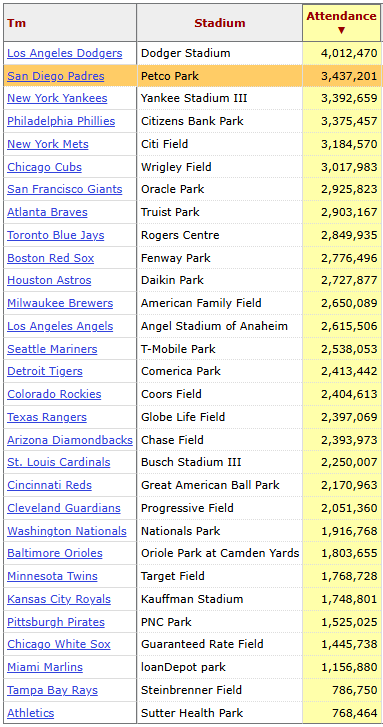
With the market cornered, the Padres have built a loyal fanbase that consistently shows up to support their team. In the 2025 season, the Padres had the second-best attended home games, ranking only behind the 2025 World Series-winning Los Angeles Dodgers.
Petco Park
Built in 2004 for $294 million, the Padres’ home of Petco Park is considered “one of San Diego’s most valuable public assets.” A recent report commissioned by the Padres showed that the stadium had a regional economic impact of nearly $913 million in 2024 thanks to a combination of Padres games, concerts, community activities, and other sporting events.
What makes Petco Park so unique is its architectural integration with downtown San Diego. Rather than being far away from the heart of the city or cordoned off by parking lots and side streets, Petco Park itself is the center of the bustling downtown scene that continues to grow around it, further enmeshing the stadium with the very identity of the city. With the stadium in 70% – 30% ownership split between the City of San Diego and the Padres until 2034, there is a clear opportunity for continued growth at the stadium even beyond the Padres and their well-attended games.
What Can Businesses Learn From This?
Acquisitions are often about more than the numbers on the page; they encompass the full breadth of what a business has to offer potential buyers. For the Padres, they provide access to a loyal fanbase with money to spend and a gem of a stadium that drives additional revenue as a valued community asset. These advantageous elements exist in addition to the actual strength of the team, which is currently holding the final National League Wild Card spot late in the 2026 season.
In statements following the announcement, Feliciano and Jones described their excitement to lead the team and desire to bring a World Series Championship home to San Diego. While their passion for baseball excellence may have inspired them to acquire an MLB team, the Padres’ unique offerings are what make the team an ace acquisition from a business standpoint.
Have questions about how to assess the full value of a business in a transaction? Contact M&A and Corporate lead Connie Phelps at cphelps@berenzweiglaw.com.
DISCLAIMER: Because of the generality of this update, the information provided herein may not be applicable in all situations and should not be acted upon without specific legal advice based on particular situations.
©2026 Berenzweig Leonard LLP. This material is provided for informational purposes only. It is not intended to constitute legal advice nor does it create a client-lawyer relationship between Berenzweig Leonard and any recipient. Recipients should consult with counsel before taking any actions based on the information contained within this material. This material may be considered attorney advertising in some jurisdictions. Prior results do not guarantee a similar outcome.